Dental Core Training Handbook

- Letter from Postgraduate Dental Dean
-
Dear Colleague,
Hello and welcome to Health Education and Improvement Wales (HEIW) and the next step in your career progression. HEIW is an independent body in NHS Wales and is responsible for ensuring Wales has the right staff with the right skills to deliver world-class care to the people of Wales: You are very much part of that aspiration.
Dental Core training exists to allow you to apply the knowledge that you have acquired during your previous dental training and to further develop this in a supportive clinical environment. The programme is designed to meet your needs and requires your full participation and a positive attitude to experience the maximum benefit.
You will be in control of your own personal development and will need to liaise closely with your educational supervisor in achieving your individual targets identified at the start of your core training placement.
All Trainees are expected to participate in study days, either the fixed study days attached to the DCT1 schemes or a mixture of set study days along with utilising the study allowance provided to each DCT2 and DCT3 Trainee enabling you to attend training, courses, or conferences of your choosing.
Trainees must also complete an e-portfolio (e-PDP) which records everything relating to training, including but not limited to; clinical experiences, workplace assessments, case-based discussions, and Trainee reflections. The study days are designed to be interesting, relevant, and educational. Your feedback on the study days and on any aspect of the training programme is most welcome and will help us to ensure we are continuously improving.
We hope you will make many friends and develop valuable networks during your dental core training which will last a lifetime.
If you have any concerns about the programme or any related matters that cannot easily be resolved locally in your place of work, please let us know: your Training Programme Director, Educational Supervisor and our HEIW staff are always available to help.
May I take this opportunity to wish you every success during dental core training and in developing and achieving your future aspirations.
Yours faithfully,

Kirstie Moons
Postgraduate Dental Dean
Health Education and Improvement Wales
- Health Education and Improvement Wales (HEIW) Contacts
-
HEIW Headquarters / Pencadlys HEIW, Tŷ Dysgu, Cefn Coed, Nantgarw, CF15 7QQ

Angharad Truman
Associate Dean for Dental Core Training
Email: Angharad.Truman@wales.nhs.uk

Karen Hailes
Dental Core Training Manager
Email: Karen.Hailes3@wales.nhs.uk
Ms Rachel Morgan
Record of Competency Progression Manager
Tel: 01443 846316
Email: Rachel.Morgan30@wales.nhs.uk - DCT Scheme Training Programme Directors
-
CARDIFF SCHEME

Dr David Johnson
Contact Details:
Medical & Dental Education Centre, Routledge Academic Centre,
Llandough Hospital, Penlan Road, Penarth, CF64 2XX
Scheme Administrator: Ms Mollie Lewis
Email: mollie.lewis@wales.nhs.ukMERTHYR SCHEME

Mrs Anjani Holmes
Contact Details:
Dental Postgraduate Unit, Unit 3, Prince Charles Hospital,
Merthyr Tydfil, CF47 9DT
Email:
Tel: 01685 728319/ 8231

Ms Esther Brewer
Contact Details:
Dental Postgraduate Unit, Unit 3, Prince Charles Hospital,
Merthyr Tydfil, CF47 9DT
Email:
Tel: 01685 728319/ 8231
Scheme Administrator: Mrs Julie Roberts
Email: julie.roberts12@wales.nhs.ukNORTH WALES SCHEME

Mr Chris Lloyd
Contact Details:
Clwyd North, Postgraduate Centre, Glan Clwyd Hospital
Bodelwyddan, Rhyl, LL18 5UJ
Email: christopher.lloyd@wales.nhs.uk

Ms Katherine Mills
Contact Details:
Clwyd North, Postgraduate Centre, Glan Clwyd Hospital
Bodelwyddan, Rhyl, LL18 5UJ
Email: katherine.mills2@wales.nhs.uk
Tel: 07766112551Scheme Administrator: Mrs Rosemary Roberts
Email: rosemary.roberts@wales.nhs.ukDCT 2/3 Scheme
Mr Richard Evans
Contact Details:
Dental Postgraduate Unit, Unit 3, Prince Charles Hospital,
Merthyr Tydfil, CF47 9DT
Email: Richard.Evans3@wales.nhs.uk
Ms Katherine Mills
Contact Details:
Clwyd North, Postgraduate Centre, Glan Clwyd Hospital
Bodelwyddan, Rhyl, LL18 5UJ
Email: katherine.mills2@wales.nhs.uk
Tel: 07766112551 - Getting Started
-

We appreciate a new Training Post will be a busy time for you, so we have developed the following Checklist to help assist you:
Read this handbook. Liaise with NWSSP Shared Services to complete ‘Single Lead Employer’ contract documentation and pre-employment checks if required. It is important that you do not arrange holidays for the first month of your placement as some important inductions and meetings are scheduled during this time.
Please also remember to avoid taking leave on study days.INTRO TO WARD – Some trainees taking up an OMFS post may be invited to attend a two-day "Introduction to the Ward" course. This course provides an overview of key ward responsibilities and essential clinical skills, including cannulation, suturing, and more. This will be taking place on 4th & 5th September 2025. If you are required to attend, the DCT Manager will inform you before your start date. You will also receive an induction within your local unit. Inhalation Sedation Training - Some trainees in community-based or paediatric posts may be invited to undertake inhalation sedation training. This includes a study day on Friday 26th September 2025, completion of 10 clinical cases, a logbook, and reflective case reports. If you are required to complete this training, the DCT Manager will notify you prior to your start date. Attend workplace induction and scheme study day induction. Familiarise yourself with Departmental/Local Health Board (LHB) policies. Make an appointment to see your Educational Supervisor as soon as possible, ideally within the first 2 weeks in post. Find out about your rota and timetable for the post and how to find places that you will need to travel to. Familiarise yourself with the Dental Core Training curriculum (COPDEND), AXIA e-portfolio and assessment forms. Start to think about completing the workplace-based assessments/supervised learning events (SLEs), audit project/ quality improvement project and other curriculum requirements. Book annual leave as soon as possible – please give at least 6 weeks’ notice and remember to avoid study days wherever possible. Your IT passwords will be sent to you at the start of the training post. If you already have an account on the Axia e-portfolio then your username and password will remain the same. If you don't already have an account then your username and passwords will be sent to you at the start of your training post. Register on Y Ty Dysgu - the course booking system for DCT study days and CPD courses. Ask the Key Contacts in this handbook any questions you may have.
- Dental Working and Training in Wales
-

Health Education and Improvement Wales (HEIW) delivers excellent and innovative postgraduate medical and dental education for Wales. It provides nearly 3,000 training grade doctors and dentists across Wales with access to high quality postgraduate facilities and educational support so that they can achieve their career aspirations, whilst ensuring high quality care and patient safety in Wales.
Funded by the Welsh Government, Health Education and Improvement Wales (HEIW) works in partnership with local health boards in Wales. Ongoing investment provides some of the most modern medical and dental educational facilities within the UK.
HEIW’s Dental Postgraduate Section coordinates the delivery and funding of postgraduate dental education and training programmes across Wales and provides postgraduate and post registration education and training for Dentists and Dental Care Professionals in Wales, via our network of tutors and advisors. We offer Foundation Training Programmes, Core Training Programmes, Specialty Training Programmes (Orthodontics, Oral Surgery, Special Care Dentistry, Restorative, Paediatric Dentistry, Dental Public Health, Oral Surgery, Oral Medicine and Dental & Maxillofacial Radiology) and a wide range of continuing professional development courses for the dental team.
We also run training programmes for Dental Care Professionals, including a Welsh Dental Therapy Foundation Training Programme (WDTFT).
Our priority is to ensure that our Trainees and trainers/educational supervisors are competent and confident in their roles, providing high quality, safe patient care and high quality training programmes and learning environments which are both supportive and challenging to develop our future dental workforce.
The Wales NHS Constitution and NHS Values
NHS Wales is the publicly funded National Health Service of Wales providing healthcare to some 3 million people who live in the country. The NHS has a key principle which is that good healthcare should be available to all, regardless of wealth.
Health in Wales (http://www.wales.nhs.uk/) is the website of National Health Service (NHS) Wales, and brings together information sources about health services and the health and wellbeing of the population of Wales.
Setting health policy for the NHS in Wales and the funding for health services is the responsibility of the Welsh Government.
- Aims and Objectives of Dental Core Training
-
Dental Core Training is a non-compulsory period of approved training that aims to provide dentists with the opportunity to consolidate skills acquired during their foundation year and develop and enhance new skills in specific areas of clinical practice and in different environments. Satisfactory completion of 2 years Dental Core Training will also meet minimum entry requirements to specialty training. Each stage/level of Dental Core Training lasts 12 months and there are up to 3 stages in total, DCT1, DCT2 and DCT3.
- Wales DCT Programme
-

Length of Training
Dental Core Training (DCT) can extend for up to three years: DCT1, DCT2, DCT3. Wales is unique in that we offer a mixture of fixed 12-month posts and a selection of whole time equivalent rotational posts for the DCT1 year, whereby Trainees have two posts each of 6 months duration. This enables Trainees to gain a wider range of experience within their first year of dental core training. The majority of DCT posts are for a fixed term of 12 months, though a small number are structured as 24-month longitudinal posts.
Educational Supervisor
Each Dental Core Trainee will be assigned a nominated Educational Supervisor who is responsible for overseeing educational progress, agreeing a personal development plan, undertaking progress reviews, providing regular feedback on progress to the Trainee and for providing evidence and recommendation for completion of training. S/he will encourage the Trainee to regularly complete the DCT e-Portfolio and to use the educational tools provided for support.
A Trainee should make arrangements to meet formally with their Educational Supervisor at the earliest opportunity and normally within the first two weeks of the placement starting. Each Trainee will need to complete a Personal Development Plan (PDP) as required by the GDC. This PDP should be uploaded onto the AXIA portfolio as required by the curriculum.
There should be regular meetings with your Educational Supervisor and your supervisor will need to complete formal reviews as required by the curriculum, these are to be recorded in the e-portfolio and should include: an initial review (within the first two weeks), an interim review towards the end of the first 6 months (IRCP) and a final review (RCP) in June/July.
You will meet with your Educational Supervisor to discuss expectations and complete the educational agreement. The following areas should be discussed at this first meeting:
- how to get help in a clinical situation
- department / clinic organisation and induction arrangements
- holiday / sickness / study leave policy
- supervision arrangements
- punctuality and team working
- completing the e-portfolio and reflective practice
- structured learning exercises
- dress code
The Educational Supervisor is in the best position to assess the Trainee’s needs. Through the various processes of assessments and appraisals these needs can be identified, discussed, and hopefully addressed. Educational Supervisors will encourage their Trainees to develop their own personal skills and attitudes.
If you are not sure who your Educational Supervisor is, please contact the DCT Manager.
Clinical Supervisor
Trainees will also have multiple clinical supervisors throughout the period of dental core training.
These are the consultants, specialists, specialty registrars, or any other clinical staff that you work with day to day in any of your placements. Clinical supervisors will only be responsible for you during a particular session and are responsible for ensuring that your day-to-day clinical training needs are being met. They should be asked to carry out structured learning exercises and to complete elements of your portfolio as appropriate.
Training Programme Director
Each Dental Core Training Scheme will have a Training Programme Director who is appointed by HEIW and who will be responsible for managing the scheme, arranging educational courses (study days, seminars, hands-on sessions, and audit days) and who will provide on-going support for both Trainees and educational and clinical supervisors.
The Training Programme Director’s main responsibilities are:
- act as organiser of the scheme for Trainees in the area, in liaison with the local tutor/s, Postgraduate Centre staff, Hosting Local Health Boards (LHBs)
- advise on completion and certification of training
- ensure that local records of the scheme are maintained
- attend the day release scheme and facilitate
- ensure that regular feedback occurs between educational supervisor/Trainee/TPD and that your e-Portfolios is maintained
- counsel educational supervisors and Trainees and troubleshoot problems within the scheme / programme
- give career advice
E-Portfolio (E-PDP)
Each dental core Trainee must complete a HEIW approved learning and development portfolio to provide evidence of educational and training activity.
Health Education and Improvement Wales (HEIW) uses the nationally approved AXIA e-portfolio.
Usernames and passwords for dental core Trainees will be issued and these will be sent to Trainees via email prior to the start date. It is important for Trainees to check their “junk” email folders for initial log-in details.
Portfolio support for DCT Trainees in Wales is provided by Rachel Morgan –Email: Rachel.morgan30@wales.nhs.uk
A fully completed e-portfolio is required for satisfactory completion of the training programme and this will be checked at Interim Review of Competence Progression (IRCP) in February/ March and Final Review of Competence Progression (FRCP) in July.
**Please see the detailed user guides developed by HEIW for more information on different areas of the e-portfolio how to upload evidence to the e-portfolio and to link that evidence to the curriculum items**.
The Curriculum
The Curriculum for the Dental Core Training Programme can be obtained on the COPDEND website (www.copdend.org.uk). You need to consult the September 2018 curriculum which is the current one in place for training in the UK.
The FOUR competency domains are as follows:
- Professional Behaviour and Trust
- Communication, Teamworking and Leadership
- Clinical Safety and Quality
- Good Clinical Care
Within these 4 domains there are 18 mandatory outcomes:
- Professional Behaviour and Trust
- Acts professionally
- Delivers patient-centered care & maintains trust
- Behaves in accordance with ethical & legal requirements
- Keeps practice up to date with learning & teaching
- Engages in career planning
- Communication, Teamworking and Leadership
- Communicates clearly in a variety of settings
- Works effectively as part of a team
- Demonstrates leadership skills
- Clinical Safety and Quality
- Recognises and works within limits of professional competence
- Makes patient safety a priority in clinical practice
- Contributes to quality improvement (i.e., Clinical audit or a quality improvement project - Improvement in Practice)
- Good Clinical Care
- Obtains history & performs clinical examination
- Requests relevant investigations/special tests and acts on findings
- Prescribes safely
- Performs clinical procedures safely
- Is trained in managing medical emergencies
- Promotes general and oral health
Interim Review of Competence Progression (IRCP)
IRCP takes place in February / March, prior to the changeover in rotational posts. The IRCP Panel will usually consist of the following:
- Postgraduate Dental Dean or Associate Dean for DCT
- TPD from another scheme
- RCP/E-Portfolio
List of (typical) requirements for Outcome 1 at IRCP (Note this is subject to change in line with national guidelines and developments):
- Completion of a Personal development plan (PDP) and monitored progress against that
- Initial and interim Educational Supervisor reports
- Submission of a personal development plan for each rotation
- Study Day attendance record (DCT1 Trainees Only)
- Completion of a clinical logbook (without patient identifiable criteria)
- Completion of a minimum of 12 SLEs
- Completion of a minimum of 5 reflections (must be made available for viewing on Axia e-portfolio, not marked ‘private’).
- Completion of Foundations in Improvement (DCT1 only)
- Minimum of 10 Patient Satisfaction Questionnaires (PSQs).
- Minimum of 1 Multi Source Feedback (MSF) with 10.
Final Review of Competence (FRCP)
FRCP takes place in July when a formal FRCP panel will convene to discuss Trainee progression and agree the final outcome. This panel will consist of the following:
- Postgraduate Dental Dean or Associate Dean for DCT
- Associate Postgraduate Dental Dean from a different Local Office / Deanery
- Senior Clinical Trainer or Training Programme Director from another scheme
- RCP/E-Portfolio Administrator
- Lay Rep
List of (typical) requirements for Outcome 1 at FRCP (Note this is subject to change in line with national guidelines and developments):
- Completion of a PDP and monitored-progress against that
- Initial and interim Educational Supervisor reports
- Detailed final Supervisor report prepared by Educational Supervisor
- Study Day attendance record (DCT1 Trainees only)
- Completion of a minimum of 24 SLEs (including at least one “developing the clinical teacher”)
- Completion of Audit or Quality Improvement for DCT1 or Improvement in Practice (QI) project for DCT2/3
- Minimum of 20 Patient Satisfaction Questionnaires (PSQs)
- Minimum of 1 satisfactory Multi Source Feedbacks (MSF) with a minimum of 10 participants per placement
- Minimum of 10 reflections for the training year
- Evidence of Audit or Quality Improvement project for DCT1 and Improvement in Practice for DCT2 & 3
- 18 mandatory curriculum items have been evidenced with at least 2 SLEs and each SLE has not been linked more than three times.
- CPD record compliant with GDC
On completion of the training programme a Certificate of Achievement will be issued. The certificate will list the specified outcomes that have been attained by the Trainee and define any areas of development for outcomes that were specified in the learning agreement but not acquired during the training year. Outcomes that were planned but not achieved through lack of opportunity rather than lack of competence will also be identified.
CPD Records
Since January 2018 all dentists must adhere to the General Dental Council’s “Enhanced CPD” (ECPD) scheme. Dentists will need to complete a minimum of 100 hours verifiable CPD over their five-year cycle as well as ensure they declare at least 10 hours during any 2-year period. Full details are available on the GDC website www.gdc-uk.org
DCT1 Trainees in Wales have a structured study day timetable consisting of 28 days throughout the year, plus 2 set days of self-directed study.
DCT2 and DCT3 Trainees have a smaller structured study day timetable consisting of 6 days throughout the year, plus 24 self-directed study days, where they can pursue suitable learning and development of their own choice.
From September 2023, all study days will be organised via an online course booking system “Y Ty Dysgu” and CPD certificates for each session will be available to download.
Queries Regarding Your Post
You should read and sign a contract of employment as soon as possible and certainly within 6 weeks of starting in post and you should keep a copy of your job description too.
Personnel enquiries such as contracts, pay/ banding, travel expenses, job descriptions, working hours, parental leave and similar aspects should initially be addressed to Shared Services (NWSSP).
For queries regarding your training or matters which need to be brought to the attention of Health Education and Improvement Wales (HEIW), please first contact the Training Programme Director for the scheme or the DCT Manager.
General Requirements for all Dental Core Training Posts
All Dental Core Trainees must:
- have a named educational supervisor
- have a signed educational/learning agreement at the beginning of the placement included in their e-portfolio
- have a structured induction programme tailored to the requirements of the post
- regularly and accurately complete the Training e-portfolio
- have ready access to internet, library and study facilities
- attend study days as advised by HEIW
- have a structured clinical training programme to address the major competences in the Dental Core Training portfolio and meet individual identified learning
Expectations of Trainees
Your educational supervisor has undertaken training to ensure that you receive excellent support during your training year. In response to this it is necessary for you to:
- show a willingness to learn
- foster good relationships with colleagues
- in discussion with your educational supervisor formulate a Personal Development Plan within 2 weeks of your new appointment
- maintain and update your PDP
- ensure holiday is taken in agreement with your educational supervisor and employer.
- participate in peer review and clinical audit as required
- manage all aspects of patient care
- work successfully as a member of the unit/ department/clinical team
- make competent and confident professional decisions, recognizing personal strengths and weaknesses including the need to refer and seek advice as appropriate
- practise ethically according to GDC Standards, including respect for patient confidentiality
- demonstrate that you understand that continuing professional development should be a lifelong commitment
As a registered dental professional, you are expected to maintain the GDC’s standards at all times, not only when working in your unit/department.
Occupational Health
Dental Core Trainees must complete an occupational health check prior to the commencement of training. Trainees will be contacted by Shared Services Partnership (NWSSP) with regard to completing pre- employment checks and occupational health checks.
Trainees must provide relevant health screening and immunisation details to NWSSP and follow relevant protocols for inoculation, injuries and subsequent occupational health screening.
Trainees must also take appropriate precautions in relation to safer sharps practice and use the required personal protective equipment for safe dental practice and practise infection control as per local and national guidelines.
Inform your educational supervisor and training programme director of significant events or issues relating to your occupational health.
The Postgraduate Dental Dean / Associate Dean, Training Programme Director, Educational Supervisor or hosting Local Health Board may choose to refer you to Occupational Health if there are particular health issues that may affect your ability to complete your training year. Alternatively, Trainees may complete a self-referral.
- DCT Study Days
-

DCT 1
There will be 28 Study Days over the course of the training year, organised by the DCT1 TPDs. The study days are designed to help you develop all the necessary skills and knowledge required for successful clinical practice. The majority of the courses are based at Postgraduate Centres in local hospitals, but some days may be held at other venues, online, or combined with other schemes. Days will often begin with a problem-solving opportunity where problems of any nature may be openly discussed with your peers and Training Programme Director. Study days will be a mixture of theory-based lectures, discussions and practical, hands-on sessions. Your full participation is required for their success.
DCT1 Trainees will also have 2 days for self-directed study. These days will be scheduled into the DCT1 study day timetable however may be changed with agreement from TPD and ES. These self-directed study days are intended to follow learning objectives identified within Trainees’ personal development plans and evidence of activity on these days should be recorded in the e-portfolio.
DCT2/DCT3
DCT2 and DCT3 Trainees will follow the same curriculum as the DCT1 Trainees however they are required to demonstrate greater competency levels.
DCT2 and DCT3 Trainees have a small number of structured study day sessions to attend that are organised by the Training Programme Directors. In total DCT2 and DCT3 Trainees are entitled to 30 study days per year as part of their training and development and these days should be discussed and agreed with their TPDs, educational supervisors and clinical managers. DCT2 and DCT3 Trainees also have a study allowance of £600 per year. Under the Single Lead Employer contract, Trainees will need to liaise with their Educational Supervisor regarding requests for study leave and to utilise their study allowance.
It is common for Trainees to agree the course or training with their Educational Supervisor as part of their personal development plan (PDP) and then pay for the course or training themselves before claiming the monies back using the Assure expenses system. Claims for reimbursement of the £600 study allowance will be approved by the hosting health board. Claims for reimbursement of other expenses e.g. Travel to study days (where relevant/ applicable) will be approved by the scheme administrator.
Attendance
As part of your mandatory outcomes, you are expected to actively participate in all aspects of your training and make the most of the learning opportunities available to you. Attendance at all study days organised by your scheme is strongly recommended. Limited engagement or poor attendance throughout the year will impact your ability to successfully complete Dental Core Training.
A record of attendance is kept and verifiable CPD certificates can be downloaded by Trainees from the online course management system Y Ty Dysgu.
You should not take annual leave on a study day.
Please car-share where possible.
If you are sick on a Study Day, please telephone your Training Programme Director by 9am.
Punctuality
The start time is indicated in the programme; please remember that you will be expected to be present in advance of this time. If you arrive late, you may be excluded from the course for that day.
Dress Code and Behaviour
Professional standards of dress are expected at study days and away days/ conferences. Clothing should be appropriate for the environment.
Politeness and respect for colleagues, administrative and other staff and the general public who may be present at the venue is an absolute requirement. Mobile devices such as tablets and laptops may be used to take notes only. Using these devices for anything else may result in you being asked to leave. It is not acceptable to use mobile phones at all during the educational aspects of the day-release programme and these should be switched off or on silent, except during break times.
Travel Expenses
- DCT-1: Trainees can claim travel expenses for attending study days organised by their training scheme these expenses are approved by the scheme administrator.
- DCT2/ DCT3: Trainees can claim travel expenses for attending study days organised by their training scheme these expenses are approved by the scheme administrator. For independently arranged courses or CPD events, travel costs must be covered from the £600 study budget. These must be agreed in advance with your Educational Supervisor and local unit when requesting the study leave and these expenses are approved by the hosting health board.
All trainee expenses should be claimed by the Assure expenses platform which can be accessed via mobile phones or by logging in online. Shared Services will provide Trainees with their log in details to access the Assure platform.
- Learning Management System and evaluation of study days
-
Our Learning Management System (LMS) - Y Ty Dysgu, is a platform for the healthcare profession across Wales. The LMS is the online platform where you can view and access your organised study days but it also hosts additional courses and learning materials, which you can explore in your own time or as part of your agreed self-directed study allowance
You will need to register on the site and we will add you to a content folder relevant to your scheme. On the 1st of September when you log into the site you will be able to view the relevant study events and materials for your scheme. Once a study day has been delivered you will need to log onto the site and evaluate the session, this will then generate a certificate that will need to be uploaded to the E-Portfolio.
You can access the LMS website at https://ytydysgu.heiw.wales.
- Social Media
-

In recent years social media has quickly embedded itself within our everyday lives. It presents great opportunities for organisations and individuals to listen and have conversations with the people they wish to both professionally and personally, however it is worth being mindful of the key points identified below.
- Social media can blur the boundary between an individual’s public and professional lives.
- Dentists should have conservative privacy settings - be aware that not all information can be protected on the web.
- The ethical and legal duty to protect patient confidentiality applies equally on the internet as to other media.
- It would be inappropriate to post informal, personal, or derogatory comments about patients or colleagues.
- Dentists should not accept ‘friend’ requests from current or former patients.
- Defamation law can apply to any comments posted on the web made in either a personal or professional capacity.
- Dentists should be conscious of their online image and how it may impact on their professional standing.
The General Dental Council gives the following guidance:
Social networking sites and other social media are effective ways of communicating with others on both a personal and professional level.
Social media covers a number of internet based tools including, but not limited to, blogs, internet forums, content communities and social networking sites such as Twitter, YouTube, Facebook, LinkedIn, GDPUK, Instagram and Pinterest.
Professional social networking websites aimed solely at dental professionals are also forms of social media and are covered by this guidance.
4.2.3 of Standards for the Dental Team states:
‘You must not post any information or comments about patients on social networking or blogging sites. If you use professional social media to discuss anonymised cases for the purpose of discussing best practice you must be careful that the patient or patients cannot be identified.’
When using social media, you must:
- a) Maintain and protect patients’ information by not publishing any information which could identify them on social media without their explicit consent.
- b) Maintain appropriate boundaries in the relationships you have with patients and other members of the dental team.
- c) Comply with any internet and social media policy set out by your employer.
As a registrant you have a responsibility to behave professionally and responsibly both online and offline.
Your online image can impact on your professional life and you should not post any information, including photographs and videos, which could bring the profession into disrepute.
It is important to remember that anything you post on social media is in the public domain and can be easily copied and redistributed without your knowledge. You should presume that everything that you share online will be there permanently.
Please think carefully before accepting friend requests from patients.
Regularly review your privacy settings to ensure that information is not accessed by unintended audiences, however, remember that even the strictest privacy settings do not guarantee that your information will be kept secure and any information that you post could be viewed by anyone including your patients, colleagues, or employer.
Remember that even if you do not identify yourself as a dental professional, you could still put your registration at risk if you display inappropriate behaviour whilst using social media.
You should not have discussions with your patients about their dental care and treatments on social media.
While online discussions about anonymised patients and best practice can have an educational and professional benefit you should remember that posting information under another username does not guarantee your confidentiality. Please consider how your comments reflect on you as well as how they could impact on the public’s trust in the profession.
- Trainee Representative & Trainee Forums
-

Every training year trainee forums are established to improve and encourage communication with our trainee voice across Wales. Trainee forum meetings are arranged quarterly and are in place to facilitate trainees feedback about the training in the schemes and units.
At the beginning of each training year, your TPD will invite trainees to volunteer for the role of scheme representative. If multiple trainees’ express interest, a vote will be held, and the representative will be elected by their peers within their scheme. Representatives will be in post from September 2025- August 2026.
DCT scheme representatives are expected to:
- Gather feedback from colleagues about the training provided within both their scheme and local unit.
- Attend the HEIW Dental Trainees Committee (DTC) 4 times per year. Meetings are held virtually at lunchtimes to minimise impact and disruption to trainees.
- Feedback any points raised at the DTC to their fellow trainees in a timely manner.
- Provide a testimonial video about their training experience in Wales which will then be used on our HEIW dental website and social media to support future trainees.
- Please note: If representatives are unable to attend a meeting, they should arrange for a colleague from a similar training level to attend on their behalf to represent their scheme. Apologies must be received a minimum of a week in advance of the meeting.
The dates of years meetings are:
Introductory Rep Meeting Tuesday 14th Oct 2025 1:00-1:30 pm - Teams Winter Meeting Tuesday 9th Dec 2025 1:00-1:30 pm - Teams Spring Meeting Tuesday 3rd March 2026 1:00-1:30 pm - Teams Summer Meeting Tuesday 9th June 2026 1:00-1:30 pm - Teams Completion of the role and attendance at all meetings will result in a certificate of participation being awarded.
- Sustainability
-

Sustainable Healthcare in Wales
In April 2019, the Welsh Government declared a climate emergency in Wales, and two years later published its plan for a “net-zero” NHS by 2030. In response to this pledge, the NHS Wales Decarbonisation Strategic Delivery Plan was released.
NHS Wales Decarbonisation Strategic Delivery Plan (gov.wales)
Health Education Improvement Wales (HEIW) have a role to support the implementation of this plan, but we can all play a part.
The Lancet describes climate change as “the greatest global health threat facing the world in the 21st century”.
Thinking about climate change can be frightening (this is a normal response to devastating news, and we call this eco-distress). Recognising the way that we feel, and acting, can help us to feel more positive.
Some small actions that you, as a dental trainee in Wales, could take include:
- Joining your local Green Group (there’s one in every Health Board)
- Looking at the resources available on Green Health Wales website
- Exploring active travel options to commute to work or car sharing for study days.
- Bring a reusable mug/water bottle to all study days/ sessions.
- Reduce the use of paper, as all educational content, timetables and agendas will be available in digital or electronic format.
Dentistry is facing many challenges to help tackle the problem, particularly around decontamination, waste disposal and the use of single-use plastics. NHS dental services emissions make up 3% of the overall carbon footprint of the NHS.
If you are interested in learning more about Sustainability in Dentistry, the link below will direct you to an excellent resource on the website of the Centre for Sustainable Healthcare.
Sustainable Dentistry: How-to Guide for Dental Practices | Centre for Sustainable Healthcare
Sustainable Healthcare provides hope for a healthier future and a healthier planet.
This is why the Lancet also describes climate change as “the greatest opportunity to redefine the social and environmental determinants of health”.
- Dealing with Issues
-
If you do have concerns about your training, it is important that you contact your educational supervisor immediately. If you are still not happy after having spoken to the educational supervisor, please contact the Training Programme Director. Training concerns can be raised in a number of ways.
You can raise any concerns directly with any of the following people, in person or in writing:
- Educational Supervisors
- Training Programme Directors
- DCT Manager
- Associate Dean for DCT.
HEIW and your employer both have responsibilities and generally you should first work with your employing organisation, keeping your Training Programme Director informed of progress. If there are still unresolved problems, contact the DCT Team at HEIW.
For further information look at HEIW Raising concerns and escalation guidance ) or visit the speaking up safely webpages at: https://heiw.nhs.wales/support/quality-management/raising-training-concerns/.
Raising Concerns if Patients and Colleagues are at risk
Dentists must always put the patient’s safety first and act promptly if patients or colleagues are at risk and take measures to protect them. You must take appropriate action if you have concerns about the possible abuse of children or vulnerable adults.
Dentists must be familiar with the Local Health Boards written procedures for raising concerns and be familiar with local procedures for the protection of children and vulnerable adults and know who to refer to for advice.
Concerns should be raised with your employer. However, if they fail to act on your concern, then please contact the DCT Manager at HEIW.
Educational supervisors and Dental Core Trainees must inform the TPD of any significant events at the Health Board concerning the Trainee and declare any current investigations by the GDC, Health Board or any other investigation related to their work as a dentist.
- Professional Help and Support
-

Health Education and Improvement Wales Professional Support Unit (PSU)
HEIW has a Professional Support Unit (PSU) that offers advice and support for all dentists and doctors in training to maximise training opportunity. Referrals can be made via the Director of Postgraduate Dental Education, Associate Dean, Training Programme Director(s) or by self-referral.
Contact:
Telephone: 03300 584 211
Email: HEIW.ProfessionalSupport@wales.nhs.uk
Website: https://heiw.nhs.wales/support/professional-support-unit-psu/Health Education and Improvement Wales Careers Unit
There have never been more support structures and processes in place to help you develop your career throughout your training pathway. As a dental career progresses, help is sometimes needed with:
- doubts in early months of a new training programme
- unsure about a chosen pathway or not progressing in chosen pathway
- no firm options after a recruitment round
- changes in personal circumstances e.g., health, family
- thinking about resigning
If you feel you need assistance in any of these or allied areas, please contact:
Telephone: 03300 585 002
Email: HEIW.MedicalCareers@wales.nhs.uk
Website: https://heiw.nhs.wales/careers/ - Useful Websites
-
Alcoholics Anonymous
www.alcoholics-anonymous.org.uk
British Association of Oral Surgeons
www.baos.org.uk
British Dental Association
www.bda.org
British & Irish Society for Oral Medicine
www.bisom.org.uk
British Society for Restorative Dentistry
www.bsrd.org.ukCollege of General Dentistry
https://cgdent.uk
Committee of Post Graduate Deans and Directors
www.copdend.org.uk
Defeat Depression Leaflet, Royal College of Psychiatrists
www.rcpsych.ac.uk
Dental Defence Union
www.theddu.comDental and Maxillofacial Radiology
www.bsdmfr.org.uk
Dental Protection Ltd
www.dentalprotection.org/uk/
Dental Public Health
www.bascd.orgEndodontics
https://britishendodonticsociety.org.uk
General Dental Council
www.gdc-uk.org
Healthcare Learning for Online 'Webinars' and courses
www.healthcare-learning.com
Narcotics Anonymous
www.ukna.org
NHS Careers
www.healthcareers.nhs.uk
OMFS
www.baoms.org.uk
Orthodontics
www.bos.org.uk
Paediatric Dentistry
www.bspd.co.ukPeriodontology and Implant Dentistry
https://bsperio.org.ukProsthodontics
www.bsspd.org
Special Care Dentistry
www.bsdh.org.uk
The Samaritans
www.samaritans.org.uk - Other Resources
-
GDC Standards - Principal 8: Raise concerns if patients are at risk:
Standards for the Dental TeamWelsh Government Infection Control:
Infection Prevention & Control - Public Health WalesBDA Wales
https://www.bda.org/waleshome - Appendix 1: Professional Support Unit (PSU) Referral Process (2023)
-
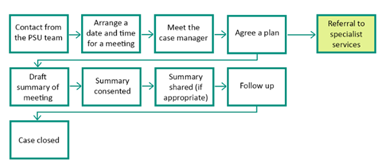
Visit the PSU webpage: https://heiw.nhs.wales/support/professional-support-unit-psu/about-the-professional-support-unit/
- Appendix 2: Maps of Main LHB Training Locations
-
University Hospital of Wales
Dental Hospital, Heath Park, Cardiff, CF14 4XY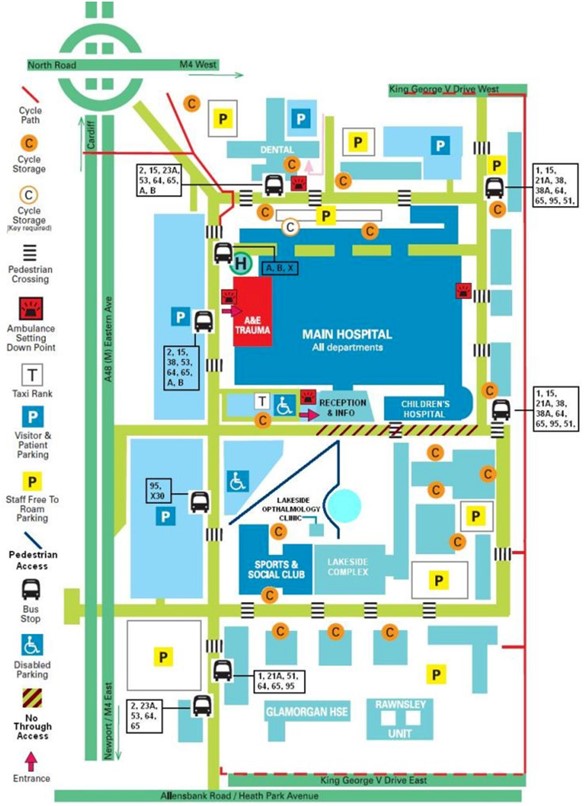
Llandough University Hospital
Penlan Rd, Llandough, Penarth CF64 2XX
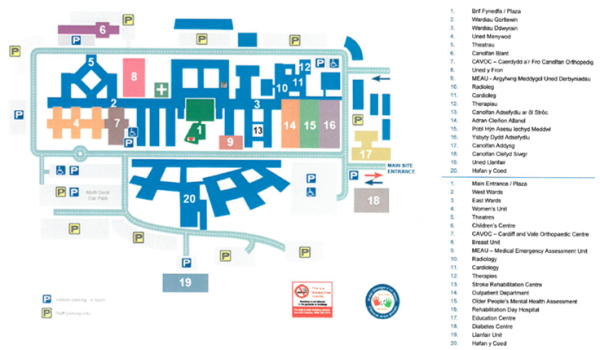
Road
Llandough hospital is 3.1 miles from Cardiff city centre, around 10 minutes by car.
Directions – From M4 Junction 33 (Cardiff West) At the Roundabout, take the exit signposted Cardiff (A4232).
Proceed along bypass for several miles, past the exits for St Fagan’s Museum and Barry.
Take the exit signposted Penarth. Take the fourth exit from the roundabout and follow the road over the bridge. At the next roundabout, take the second exit (straight over) and aim to be in the right-hand lane for the set of traffic lights. Make a right turn at these lights, passing the Merrier Harrier public house on your right.
Llandough Hospital’s entrance is 500m along, up the Hill on the left. The Routledge Academic Centre is the four storey building on your right hand side as you drive in. Continue forward for staff and visitor car parks.
Rail
The nearest main line station is Cogan which is 2.9 miles from the City Centre or 0.6 miles from University Hospital Llandough. The 10-15 minute walk is along a busy road, a taxi company is located at the train station. Trains from Barry and Cardiff central run frequently.
Bus
There is a bus stop outside the hospital entrance on both sides of the road. The 95 runs regularly from Cardiff city centre to Barry town centre via Llandough. For further details visit http://www.cardiffbus.com
Morriston Hospital
Heol Maes Eglwys, Morriston, Swansea, SA6 6NL
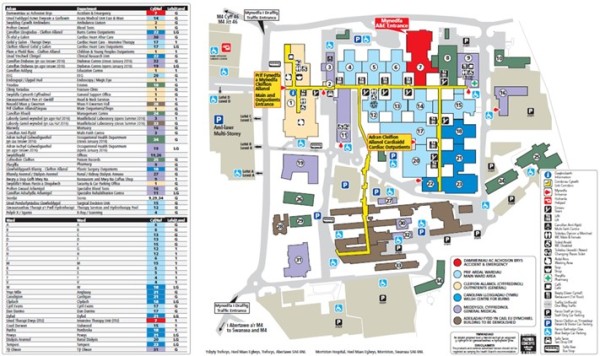
Road
Cardiff, M4 West (Warning: Speed Cameras along the M4)
Leave the M4 at junction 46, and then at roundabout take the 1st exit onto the A48 Morriston
At mini-roundabout turn left onto Pant Lasau Road
At mini-roundabout continue forward onto Mynydd Gelli Wastad Road
Turn right and arrive at Morriston Hospital.
Rail
If you are coming to Morriston Hospital by train and would like assistance in planning your journey, you may wish to use the National Rail Enquiries Journey Planner.
You can use the Train Taxi website to find details of the taxi companies that serve the train station or look at the local bus times.
Bus
There are regular buses that serve the hospital. Please visit https://www.traveline.cymru/ to plan your journey.
Glan Clwyd Hospital
Rhuddlan Rd, Bodelwyddan, Rhyl LL18 5UJ
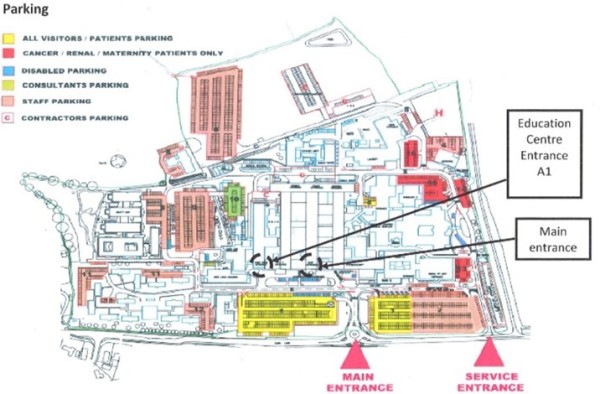
From Motorway Network (M56) to the A55
The M56 terminates at a roundabout which joins with the A5117. Follow the signposts for Queensferry & North Wales. The road numbers change over the next 5 - 6 miles through A550 & A494 until at the top of a hill outside Queensferry the A55 merges in on the left. Signposts towards Conwy should now be followed.
From Oswestry A5/A483 Roundabout to the A55
Close to Oswestry, the A5, leading from the M54 and the A483 from Newtown, meet at a roundabout and continue as the A5 to a further roundabout near Chirk. From here take the A483 Chirk by-pass and head Northwards towards Chester to a major roundabout junction before joining the A55, signposted for Conwy.
From joining the A55 to the Hospital Remain on what has become the A55 for approximately 30-35 miles. The Hospital is
signposted with official Red logos - denoting an
A&E equipped hospital - from the Marble Church exit at Junction 25. A brown Tourist Board sign for Bodelwyddan Castle, to be seen on the left, forms an additional landmark whilst the spire of the Marble Church itself is prominent on the right.
By Public Transport
Rhyl station is served via Chester by Arriva Trains Wales and Virgin’s West Coast Trains services on the London Euston/Crewe-Holyhead and Manchester-Holyhead routes contained in the All Line Timetable. Crewe is approximately 1 hour’s journey, with Manchester being 1½ hours, Birmingham New Street 2 hours, London Euston 3 hours and Cardiff just under 4 hours. Timetable information appears on the Public Transport page.
Arriva Cymru bus routes serve the hospital and depart from outside the railway station with a journey time of 17 minutes. A reduced, approximately hourly, service operates in the evening whilst on Sundays and public holidays, the service, is also hourly. Timetable information appears on the Public Transport page.
Alternatively, the station taxi rank normally has a number of licensed taxis waiting. Return taxis are frequently available from the hospital, telephone numbers being available in directories such as Yellow Pages.
NB: Some sessions of the North Wales DCT1 scheme may be held in the Wrexham Medical Institute adjacent to Wrexham Maelor Hospital, or the postgraduate education centre at Ysbyty Gwynedd in Bangor. Changes from our usual venue will be clearly shown on your advanced timetable and directions will be supplied as required.
Dental Postgraduate Department, Prince Charles Hospital Merthyr Tydfil, Mid Glamorgan, CF47 9DT
Telephone: 01685 721721 (Outpatients and Dental 12,13,14,15)
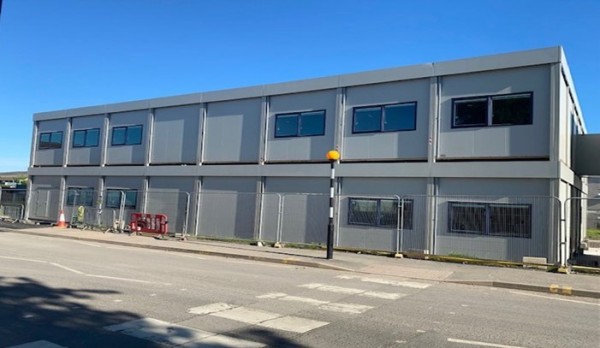
Please note the location of the DPGU has moved from the main Hospital to the ground floor of Unit 3 which is adjacent to the contractors 3 storey offices on the right hand side as you enter the Hospital Grounds.
If you require further information please contact Gaynor Owen
- HEIW Privacy Notice for Dental Core Trainees
-
Please refer to the Dental Gold Guide 2023- COPDEND for the Privacy Notice
- Single Lead Employer (SLE) Arrangement
-

Working as a Dental Core Trainee in Wales means that you will be following a Single Lead Employer Model.
The SLE Model in Wales is a collaborative employment Model, with the responsibilities of the traditional employer shared between three major stakeholders, who are:
- Single Lead Employer – NHS Wales Shared Services Partnership (NWSSP)
Overall employment responsibility including contracts of employment, employment checks, DBS checks, pay, restrictions/exclusions and disciplinary matters. The Lead Employer itself offers a single point of contact coordinating with all stakeholders.
For any queries relating to your employment, e.g., Pre employment checks, salary etc. Please contact: NWSSPSLE.Dental@wales.nhs.uk.
- Host Organisation
Provides day-to-day management and supervision of training by clinical and Educational Supervisors.
- Health Education Improvement Wales (HEIW)
Ensures the delivery of high-quality education and training which includes recruitment into training programmes, support and assessment programmes, faculty development and quality monitoring of placements. All three stakeholders’ primary function is to ensure that trainees complete their training satisfactorily and in doing so provide an excellent service to the local health and social care sector in Wales. For any queries relating to your Dental Core Training year, please contact your Training Programme Director in the first instance and or HEIW.DCTEnquiries@wales.nhs.uk.
The benefits of a Single Lead Employer to Core Dentists are that for the whole of the training scheme the trainee will have one employer. It is anticipated that the model will reduce bureaucracy, provide greater equity, and improve the working experience for trainees.
Here are a few things to consider in relation to the SLE arrangement:
- Employment / Host Organisation Related Information
-
Single Lead Employer
Since September 2021 NHS Shared Services (NWSSP) is the Single Lead Employer for Dental Core Trainees in Wales (except for Dental Public Health Trainees). NWSSP is an independent mutual organisation, owned and directed by NHS Wales. It was set up on 1st April 2011 to provide a range of high quality, customer-focused professional, technical and administrative services on behalf of all Health Boards and Trusts in NHS Wales. The benefits of the Single Lead Employer model include:
- Employment with a single employer for the duration of the training programme.
- One set of employment checks as trainees rotate from placement to placement.
- Consistent use of policies and procedures.
- One contract of employment and benefits associated with continuity of pay through organisation.
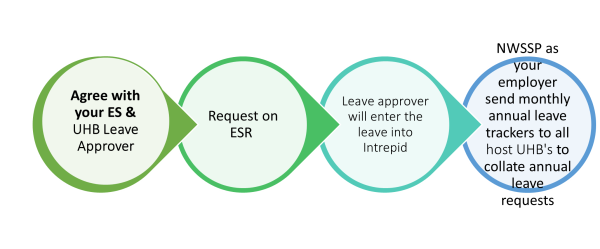
Following your appointment, you will receive a welcome email and FAQs from NWSSP confirming details about Pre – Employment Checks, Electronic Staff Record (ESR) and expenses details, annual leave etc.
NWSSP will be your first point of contact should you have any queries in relation to your employment during your Dental Core Training Programme: Dental@single-lead-employer.zendesk.com
NHS Wales email account
As an employee of NWSSP you will have an @wales.nhs.uk email address. All official documentation will be sent to your NHS Wales email address. It is important therefore that you check your account regularly. Please make sure you can access this as soon as possible. If you require assistance with accessing your account, please contact: it.servicedesk@wales.nhs.uk
Electronic Staff Record (ESR)
As an employee of NWSSP you will have access to Electronic Staff Record (ESR). This is where the SLE will record absences and special leave on behalf of host organisations. Your ESR password will be sent to your NHS Wales email address. NWSSP operate a paperless payslip system so payslips will be available to view and download from ESR. Please keep your personal information up to date on ESR as we rely on this information should we need to contact you for any reason. If you have any queries regarding your ESR account, please contact the ESR Support Hub at esrhub.wales@wales.nhs.uk
Expenses
All Dental Core Trainees are entitled to claim relocation, business and excess travel expenses. All claims must normally be made within 3 months of the event/expense.
Upon commencement of your training post, you will be provided with an Assure Expenses account by NWSSP to enable you to claim these expenses.
- Relocation expenses
New starter dental specialty trainees who are eligible to claim Relocation Reimbursement can claim against their Relocation Budget as per the All Wales Relocation - NHS Wales Shared Services Partnership. Claims can be made via your Assure Expenses account (select Approval Group: ‘Junior Relocation’/ Type of Expense: as appropriate)
- Study leave & Study budget
Eligible dental trainees are entitled to 30 days Study Leave per year and an annual £600 Study Budget (Sep-Aug each year). See the HEIW Study Leave Policy at: https://heiw.nhs.wales/files/policies-and-procedures/all-wales-study-leave-policy-for-doctors-and-dentists-in-training.
The process to claim expenses against your Study Budget is as follows:
- Apply for your Study Leave first via the Intrepid Database (this is approved by your hosting Health Board).
- Record the associated estimated expenses on Intrepid at the same time.
- Once the event has taken place claim any associated fees, travel and subsistence costs via your Assure expenses account, uploading all relevant receipts (select Approval Group: ‘Junior Doctor – 043 Dental’ / Type of Expense: as appropriate).
- Actual expenses claimed will then be recorded on Intrepid by the approver, once approved.
- Refer to Intrepid for your remaining study budget balance
- Business Mileage (for those travelling to other sites as part of their job, e.g., to community clinics)
*PLEASE NOTE: The Intrepid system is being replaced by a new platform called CODI. Once the transition takes place, you will receive instructions on how to set up and access the new system.
Dental Core Trainees who need to travel to other hospital or community sites as part of their job are entitled to claim Business Mileage. The process to claim Business Mileage is as follows:
- Ensure that you have business insurance added to your vehicle insurance policy.
- Claim via your Assure Expenses account (select Approval Group: ‘Junior Doctor – 043 Dental’ / Type of Expense: ‘Business Miles M&D’)
- Mileage claimed cannot include the mileage that you would normally travel from your home to your base site.
- Excess Mileage (for those working permanently at split sites, e.g., Orthodontics jobs with 2 hospital sites)
Dental Core Trainees who permanently work at split hospital sites as per their Job Description can claim Excess mileage (which is different to business mileage). We are currently utilising the Relocation Reimbursement system for these claims (see Question 5 in the FAQs document: All Wales Relocation - NHS Wales Shared Services Partnership. The process to claim Excess Mileage is as follows:
- Complete the NWSSP Excess Mileage Application Form at: Useful Documents for Expenses (sharepoint.com) in order to be set up for excess travel claims on the Assure Expenses system.
- Claim via your Assure Expenses account (select Approval Group: ‘Junior Relocation’/ Type of Expense: as appropriate)
- Mileage claimed cannot include the mileage that you would normally travel from your home to your primary base site.
8.5 Sickness/Absence from training
How to request leave
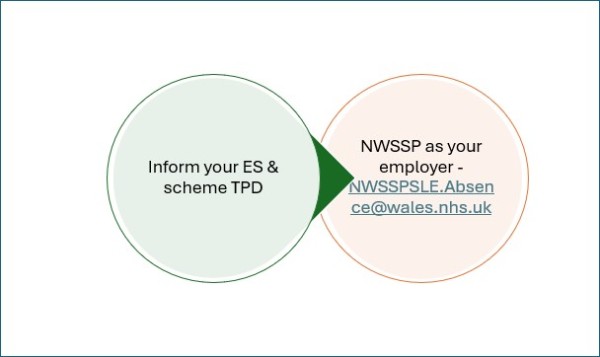
Reporting sick leave
- Flexibility and Support in Training
-

Less Than Full Time Training (LTFT)
LTFT training (or part time training) is now an integral part of Postgraduate Training in Wales. We have a flexible approach to LTFT training; all trainees can request to train on a less than full time basis. HEIW along with Training Programme Directors are committed to managing LTFT training in such a way that it is available to as many trainees as possible. If you wish to train Less Than Full Time (LTFT) please refer to the Dental Gold Guide 2023 - COPDEND for further information or contact the DCT Manager.
- Trainee Data and Data Management
-

Notification of Change in Circumstances
You must notify the DCT Administrator and NWSSP as soon as possible if you have/intend to have a change in circumstances, whilst you are in your training programme. Changes could affect how your salary payments are made and your end of training date, therefore it is imperative you notify all relevant teams.
Updates/changes that need to be notified:
- Change to personal details such as change of address or email etc
- Out of Programme Applications.
- Inter Deanery Transfer Applications.
- Notification of periods of absence owing to ill health, maternity/paternity leave or jury service.
- Resignation from a Training Programme.
Equality Monitoring Data
HEIW is committed to supporting a multi-professional, diverse workforce that represents staff across the whole of NHS Wales and the patients we all ultimately serve. It is vital that all staff and trainees we support feel welcome, are treated fairly and are all enabled to reach their full potential. We are committed to creating opportunities to implement programmes of work that directly address Differential Attainment across our trainees. To achieve this and ensure that our future strategies and policies take into account the diversity of the trainees we support, please ensure that you complete Equality Monitoring questions on any surveys we release.
- HEIW Privacy Notice for Dental Core Trainees
-
This privacy notice is intended to provide transparency regarding what personal data HEIW will collect about you, how it will processed and stored, how long it will be retained and who will have access to your data.
HEIW is a data controller in respect of the personal data it holds concerning Dentists in Wales.
Personal data is information from which an individual can be identified either directly or indirectly when the information is read in conjunction with other data that a data controller holds.
From 25 May 2018 the Data Protection Act 1998 was replaced by the General Data Protection Regulation, and this is the principal piece of UK legislation concerning personal data. HEIW is subject to the General Data Protection Regulation.
Dental Core Trainees (DCTs) should be aware that this privacy notice applies to all the processing of your personal data by HEIW in relation to or arising from your role.Why your personal data is collected
Your personal data is collected and held for the purposes of:
- supporting the management of the training programmes – personal data collected for this purpose will be kept in your training file, which will typically contain your recruitment data (Application form, recruitment documentation and an immigration records), Interim Record Competency Progression (IRCP) and Final Record of Competency Progression (RCP) summary and any significant communication and information pertinent to the effective management of your training and
- to quality assure training programmes and ensure that standards are maintained - via local and national quality assurance teams such as feedback opportunities following each Study Day with Training Programme Directors (TPDs).
- identifying workforce planning targets – your data may be used to determine areas that we can focus on to help build the dental workforce in Wales
- maintaining patient safety through the management of performance concerns. – Your personal details may be shared with the General Dental Council (GDC) should there be significant concerns regarding your fitness to
- to communicate with you about training opportunities, events, surveys, e-Portfolio activity and information that may be of interest to
- to facilitate a transparent approach to Dental Core Training in Wales
- to support and advise all stakeholders involved with Dental Core Training in Wales
- to ensure we are able to provide DCT welfare / pastoral care if necessary
- safeguarding information
- accessing library resources
The functions of HEIW are carried out in the public interest. The processing of DCTs personal data is necessary for the purposes of those functions. Sensitive personal data that we may need to share includes information relating to your health or criminal record should your employer or the GDC need to be made aware.
How your personal data is collected
Personal data is collected when you enter the DCT National Recruitment process and submit the Dental Core Training Educational Agreement. Personal data is also captured and stored on the e-PDP for one year.
How your personal data is kept secure
Access to your personal data is restricted to the authorised team within Health Education England (HEE), and the DCT Team within Health Education and Improvement Wales (HEIW).
Your personal data will be retained for six years after you have left your DCT role, at which point your personal data will be confidentially and securely destroyed.
How and why your personal data may be shared
This information is kept in a hidden electronic database with limited access.
Your personal data may be shared with:
- Welsh Government
- NHS Wales Shared Services Partnership (NWSSP)
- NHS Business Services Authority (NHSBSA)
- Local Health Boards (LHBs)
- Health Education England (HEE) – for the Electronic Personal Development Portfolio (EPDP)
- Committee of Postgraduate Dental Deans and Directors (COPDEND)
- Third parties for reporting or research purposes
HEIW will only transfer your personal data to third parties using secure channels and where it is needed to manage your Dental Core Training role, for example issues with performance and professional registration and integrity or issues relating to payments.
HEIW will not transfer your data unless it is satisfied of the following matters:
- That there is a fair and lawful basis to share your personal data with the third
- The data will be handled by the third party in accordance with the law on data
Where the data is used for analysis and publication by a recipient or third party, any publication will be on an anonymous and aggregated basis and will not make it possible to identify any individual. This will mean that the data ceases to become personal data.
Third parties may include the following non- exhaustive list: British Dental Association (BDA), Welsh Government, GDC, Occupational Health, Health Inspectorate Wales (HIW).
Your rights and responsibilities
It is important that you work with us to ensure that the information we hold about you is accurate and up to date so please inform Health Education and Improvement Wales (HEIW) immediately if any of your personal data needs to be updated or corrected.
All communications from HEIW will normally be by email. It is therefore essential for you to maintain an effective and secure email address, or you may not receive information.
If at any point you wish to gain a copy of your personal data that is held by HEIW you may submit a subject access request in writing.
In certain limited circumstances, you have a right to object to processing that is likely to cause you damage or distress, or to any decisions made by automated means that significantly affect you.
You also have a right to have inaccurate personal data rectified, blocked, erased, or destroyed.
If you wish to exercise any of these rights or have any concerns in relation to how your personal data is processed, please contact HEIW.
Should you wish to learn further information about data protection, please visit the Information Commissioner’s Office (ICO) web site. The ICO deals with complaints about how data controllers have dealt with information matters and provides useful guidance.